Language Perspective (cs.CL)
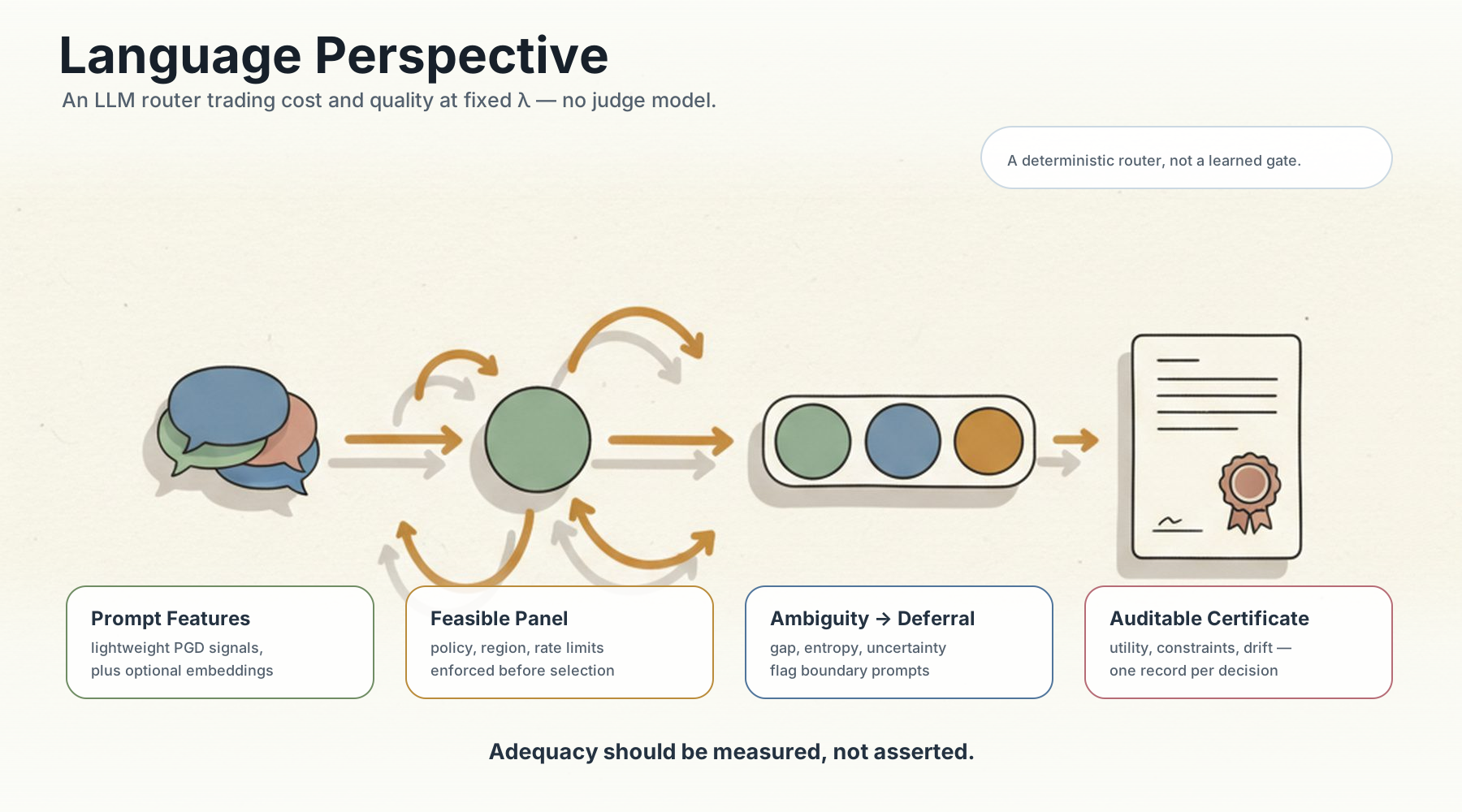
This page frames Compitum for cs.CL reviewers: an NLP router for LLM tasks that trades cost and quality at fixed willingness-to-pay (lambda), enforces policy/region constraints, detects ambiguity, and emits an auditable certificate per decision — all without a judge model.
Related: cs.LG · cs.SY · stat.ML · SRMF ⇄ Lyapunov · Peer Review Protocol · Certificate Schema
Problem in NLP Terms
Inputs: prompts and light-weight prompt-derived features (PGD), plus optional embeddings.
Models: a small set of LLM backends (fast, thinking, auto) with different quality/cost/latency profiles.
Objective: maximize utility U = quality − lambda * total_cost at fixed lambda, subject to constraints (e.g., region/policy/rate).
Decision: route each prompt to the best feasible model; optionally defer when ambiguity is high (boundary region).
Code anchors: src/compitum/router.py:80 (route), src/compitum/constraints.py:36 (feasibility), src/compitum/energy.py:33 (utility), src/compitum/boundary.py:19 (ambiguity), src/compitum/router.py:25 (certificate schema).
What We Emit (Certificate)
Per decision, a certificate exposes:
utility components (quality, latency, cost), overall utility U
constraints (feasible, approximate local shadow prices)
boundary diagnostics (gap to runner-up, entropy, uncertainty)
drift/trust-region state (for online adaptation)
This makes routing auditable and suitable for post-hoc error analysis and deferral policies.
Relation to cs.CL Literature
Mixture-of-Experts and routing: Compitum is a deterministic router across a small panel of LLMs, optimizing a scalarized utility with constraints, not a learned soft gate within a single model.
Selective prediction/abstention: boundary flags align with deferral; we measure deferral quality against high-regret items.
Cost-aware evaluation: fixed lambda slices capture cost–quality tradeoffs; we report regret, win rate, and cost deltas (when available).
Calibration: we use calibrated component predictors and report reliability of uncertainty vs. absolute regret.
Constraints and Safety
Policy/rate/region constraints are enforced before selection (feasibility-first); constraint compliance should be ~100%.
Approximate shadow prices (finite-difference viability) help identify binding constraints; they are diagnostic only.
Coherence and Ambiguity
A metric-aware KDE prior (whitened) nudges decisions toward familiar contexts with predictable behavior.
Boundary diagnostic combines gap, entropy, and uncertainty to flag ambiguous prompts where deferral or conservative routing is prudent.
Evaluation for cs.CL
Panel and per-task summaries at fixed lambda (e.g., 0.1 and 1.0):
regret and win rate vs best baseline
boundary/deferral rate and quality
optional cost delta on wins if cost columns are present
Calibration diagnostics: reliability curve (uncertainty bins) and Spearman rho(uncertainty, |regret|).
Constraint compliance rate (~100%).
Helper commands:
cs.CL summary
python tools\analysis\cl_summary.py ^
  --input data\rb_clean\eval_results\<latest-compitum-csv>.csv ^
  --out-json reports\cl_summary.json ^
  --out-md reports\cl_summary.md
Reliability curve and CEI (see docs/Statistical-Notes.md and docs/Control-of-Error.md)
Decision curves (ambiguity-based deferral upper bound + boundary AP/AUROC)
python tools\analysis\cl_decision_curves.py ^
  --input data\rb_clean\eval_results\<latest-compitum-csv>.csv ^
  --quantiles 0,0.05,0.1,0.2,0.3,0.4,0.5 ^
  --out-json reports\cl_decision_curves.json ^
  --out-md reports\cl_decision_curves.md ^
  --out-png reports\cl_decision_curve.png
Reproducibility
Deterministic evaluation with fixed seeds and offline artifacts.
Attach reports/cl_summary.md, reliability_curve.md/png, cei_report.md, fixed_wtp_summary.md.
Determinism & Explainability (0.2.0)
Determinism
Repeated route and batch determinism under fixed seeds/embeddings.
Tests:
tests/invariants/test_invariants_router_determinism.py,tests/router/test_router_batch_determinism.py
Paraphrase robustness
Flip budget under small lexical/format edits; flips must be explainable via certificate deltas (distance or feasibility changes).
Tests:
tests/invariants/test_paraphrase_invariance.py,tests/invariants/test_paraphrase_explainability.py
Limits (cs.CL)
No judge model; utility proxies depend on upstream task scoring and pricing assumptions.
Shadow prices are approximate diagnostics; coherence prior is bounded and small-weight.
Router panel size is intentionally small; extending to larger panels is future work.